
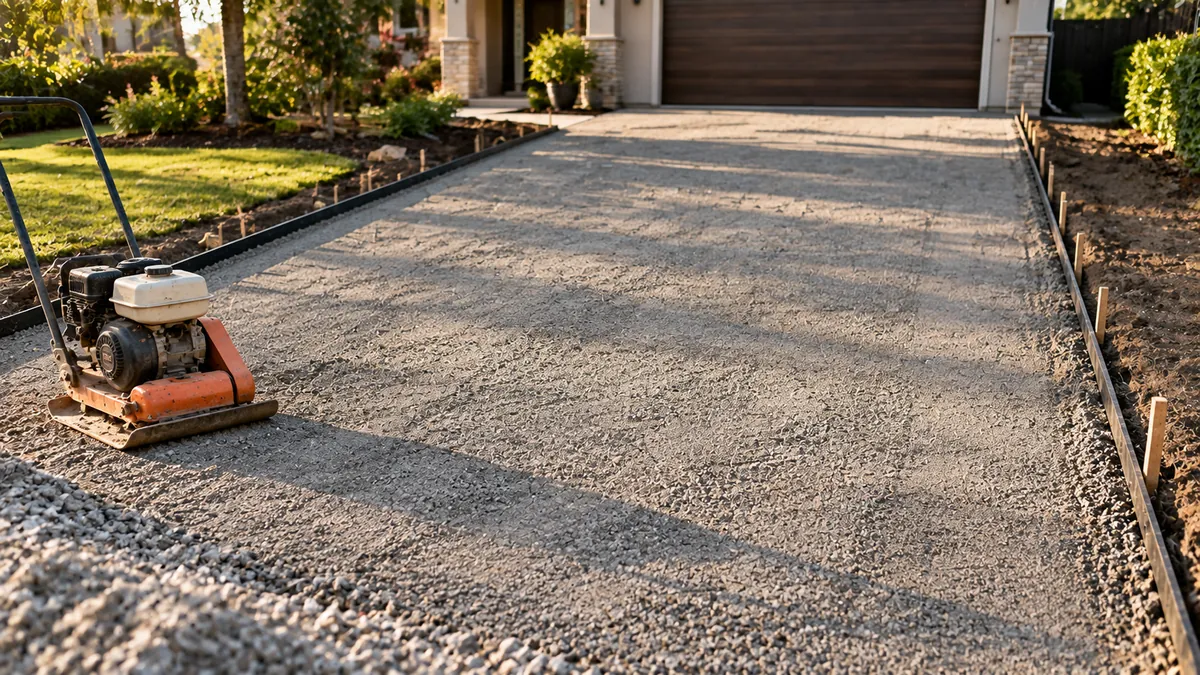
We dig out the old surface first
Before pavers go down, we break out the failed asphalt or concrete and grade the ground so rain runs away from the house. Rated 4.9 from 193 Google reviews.
Failed asphalt comes out before anything else
Most of this work starts with a driveway or slab that has already failed. The asphalt is cracked into plates, or an old concrete pad has heaved and split. We break it up and haul it off the property. Nothing new gets laid over the top of it, because a paver set on broken asphalt will follow every crack and dip underneath it.
Then we dig. How deep depends on what the pavers will carry, and a driveway that takes cars needs more depth than a walkway ever will. Old base material and soft fill come out until we reach ground that does not give under a boot. Buried debris or dark organic soil from an earlier build has to go too. It rots and settles long after the pavers are down.
Once the hole is clean, we grade and compact. The ground gets shaped to a slight slope so rain runs off, then packed with a plate compactor until it stops moving. That packed ground is what everything else sits on. If it is soft in one corner, the pavers above that corner will drop. No amount of sealing or pressure washing later will hide a low spot that holds water.
- Old asphalt or concrete broken out and removed
- Roots and soft fill dug out
- Ground graded so rain runs away
- Each layer packed with a plate compactor
- Site looked over before we dig
Grading decides where the rain goes
Clearwater gets heavy rain most summer afternoons, and a lot of it lands on driveways and patios. Where that water goes depends on the shape of the ground under them. Pavers follow that shape exactly. Water always finds the low side. If the low side is your garage door or the slab of the house, that is where it will pool after every storm.
Most houses around Clearwater and Largo are concrete block with stucco, built on a slab at ground level. There is no crawl space and no basement to give water somewhere else to go. So we grade the ground to fall away from the house and toward the street or a lawn that can soak it up. We check that slope before any base goes in.
Skip this step and the damage comes slowly. Water that sits against a block wall wicks up into the stucco and stains it. Water that sits on the pavers washes sand out of the joints and softens the ground beneath. The surface then dips right where the puddle forms. A patch job never fixes that. The ground under it has to be regraded.
Sandy soil and roots break old asphalt
Pinellas sits on sand, and sand moves when water runs through it. An old asphalt driveway with no real base under it loses support at the edges first. You see the edges crumble into the lawn, then cracks spread inward until the surface breaks into small plates. By the time a driveway looks like that, the problem is underneath it, and a new top layer will crack along the same lines.
Trees do the rest. Big shade oaks are common on older lots around Clearwater and Dunedin, and their roots reach well past the branches. A root under asphalt lifts it into a ridge, and the crack along that ridge lets water in. When we dig out a driveway like this, the roots in the way come out too. That keeps them from pushing up the new surface.
Heat adds its own damage. Asphalt goes soft on a summer afternoon here, and a parked car or a turning tire leaves a dent that never comes back out. Add years of sun that dries it gray and brittle, and the driveway breaks apart when you pick at it. Asphalt in that state cannot be patched back into good shape, so we remove it and start again from the ground.
Pavers on unprepared ground will sink
A paver job laid on ground nobody prepared can look fine the week it goes in. The trouble shows up after the first summer of storms. Soft spots settle at different rates, so the surface turns wavy and the joints open up. Weeds find those gaps, and loose pavers start to rock underfoot. Fixing it means lifting the pavers and doing the ground work that was skipped.
That is why the ground work takes the time it does. We spread the base rock in thin layers and pack each one, instead of dumping it all in at once. A compactor can only firm up so much depth in one pass. We run string lines and check the slope as we go. It is slow, dusty work that nobody sees once the pavers cover it, and it decides how long they stay flat.
Customers notice the result even if they never see the prep. Massimiliano Esposito wrote: "The pavers came out clean level and professional with great attention to detail." Level comes straight from the ground work. It is the part you notice every time it rains. On a job fixing existing pavers, Michael Schacter wrote: "The team worked quickly and left everything looking brand new."
Need an old driveway dug out?
Call (813) 330-4403 or ask for an online estimate, and we will look at the site before we quote the job.
What 193 homeowners said
Every quote below is a real review, word for word, from our Google profile.
Citrus Pavers did an excellent job on our circular driveway, incorporating a beautiful paver design that complements the architectural style of our home. Their workmanship and quality have greatly improved our property's curb appeal and functionality.
The Citrus Pavers team brilliantly executed a paver installation around our new hot tub, enhancing the aesthetics while ensuring safety with non-slip surfaces. Their work has made our spa area not only safer but significantly more stylish.
Citrus Pavers did an amazing job installing my driveway. The work came out absolutely beautiful and the attention to detail really shows. Everything was done professionally and on time. I highly recommend them 100%!
We had a great experience with Citrus Pavers. Michael rented our compactor and was a pleasure to work with. He was an excellent communicator, very polite, and took great care of the equipment. Everything went smoothly from start to finish. We would definitely rent to him again and highly recommend both Michael and the company
Citrus Pavers did an great job fixing my pavers. They were professional, efficient, and detail-oriented from start to finish. The team worked quickly and left everything looking brand new. I was impressed by the quality of their work and the open communication throughout the project.
Citrus Pavers did an excellent job on our project from start to finish. The team showed up on time communicated clearly and worked efficiently. The pavers came out clean level and professional with great attention to detail. Pricing was fair and the whole process was smooth.
Call now for a free paving quote
We do not recommend it. Old asphalt keeps cracking and settling under whatever sits on top of it, and the pavers follow it down. We take the asphalt out and build up from packed ground instead.
The edges have the least support. Sandy Pinellas soil washes out from under them in heavy rain, and the asphalt breaks off into the lawn. Once that starts, the cracks work inward toward the middle.
It depends on what the surface will carry and what we find when we open the ground. A driveway for cars needs more depth than a garden path, and soft fill or roots mean digging further. We look at the site before we give you a number.
That is the point of the grading. We shape the ground so it falls away from the slab and toward the street or the yard. On a block and stucco house, that keeps rain from sitting against the walls.
Roots inside the dig area come out with the old surface, because they will lift new pavers the same way they lifted the asphalt. If a big tree sits close to the driveway, we talk it through with you before cutting anything.
Yes. We lift the pavers in the low area and repack the ground under them before they go back down. Topping up the sand alone does not last, because the soft ground is still there.
Tell us about your paving project.
Tell us what's there now and what you want built, and we'll set up a time to look at it.
- Monday to Friday5:00 AM to 10:00 PM
- Saturday to Sunday6:00 AM to 9:00 PM